India Investigates Tata Electronics Data Breach That Exposed Apple's Unreleased iPhone 18 Pro Secrets
The Indian government has launched an investigation into a major cybersecurity breach at Tata Electronics after confidential documents related to Apple's…
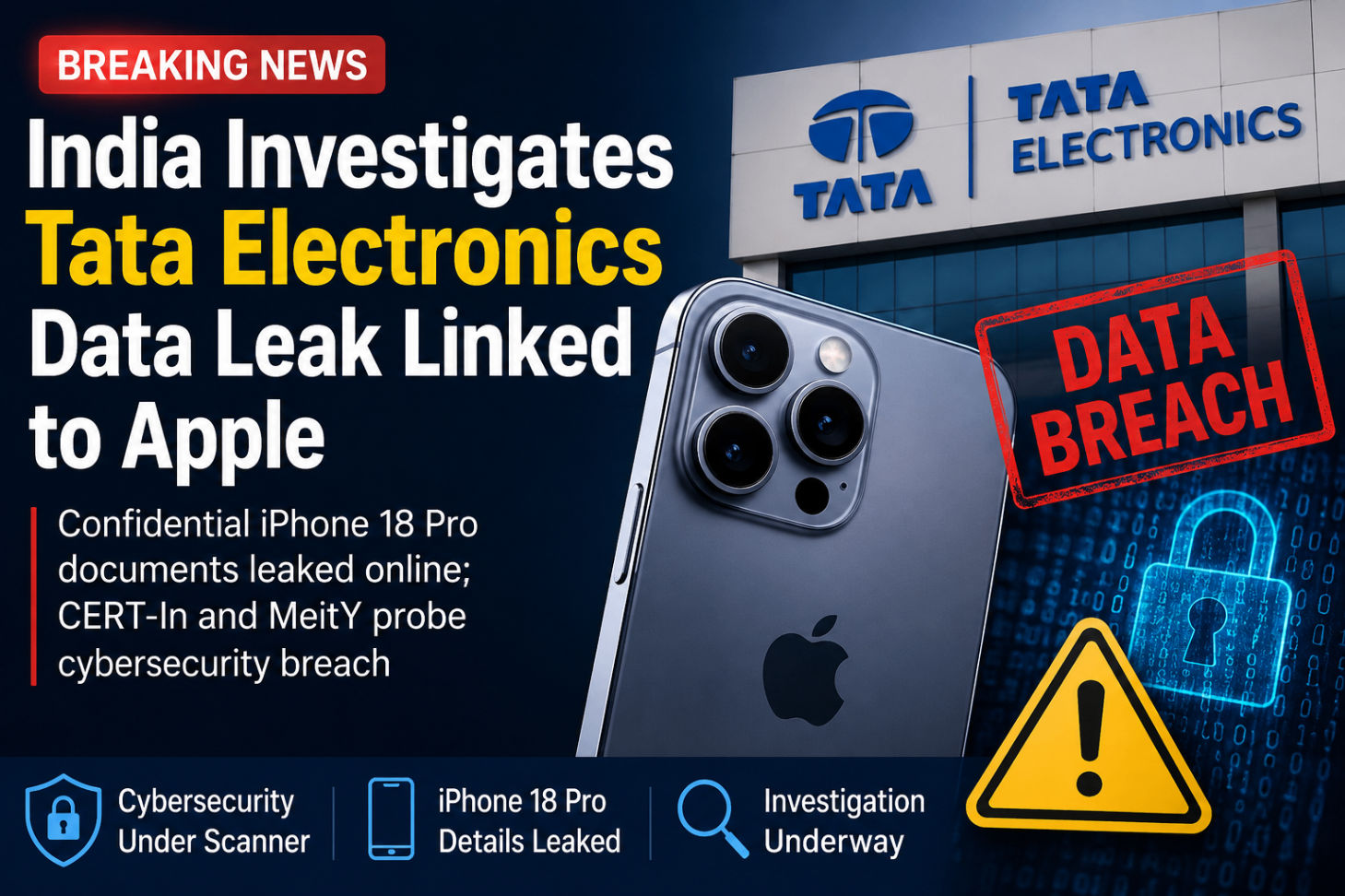
India has officially begun investigating a significant cybersecurity incident involving Tata Electronics, one of Apple's key manufacturing partners in the country. The investigation follows the leak of confidential files allegedly stolen by a ransomware group and published on the dark web.
According to government officials, the matter has been reported to the Indian Computer Emergency Response Team (CERT-In), while the Ministry of Electronics and Information Technology (MeitY) is overseeing the investigation.
The leaked data reportedly includes confidential supplier information, internal component lists, manufacturing documents, and photographs linked to Apple's upcoming iPhone 18 Pro, which is expected to launch later this year. Industry experts say such information is among the most closely guarded within Apple's global supply chain because it reveals details about manufacturing partners and product development before public release.
The breach is believed to have originated from Tata Electronics, which has become one of Apple's most important manufacturing partners outside China as the company expands its production footprint in India. Besides Apple, reports indicate that documents related to Tesla, Qualcomm, and TSMC were also found among the leaked files.
In response to the incident, Tata Electronics has initiated a forensic investigation with the help of an independent cybersecurity consultant and strengthened internal security controls while the investigation continues. The company has stated that business operations remain unaffected.
The incident comes at a crucial time for India's electronics manufacturing ecosystem. The country has rapidly emerged as a strategic manufacturing hub for Apple, with a growing share of global iPhone production shifting to India under Apple's supply chain diversification strategy.
Cybersecurity experts believe the breach highlights the increasing risks facing global manufacturing companies as cybercriminals target intellectual property, confidential product information, and supply chain data. The incident is expected to encourage stronger cybersecurity practices, tighter vendor risk management, and greater investment in data protection across the technology manufacturing industry.
Why This Matters
- India is becoming one of Apple's largest manufacturing hubs.
- The breach exposes potential cybersecurity risks within global supply chains.
- It reinforces the importance of cybersecurity, data governance, and third-party risk management for technology companies.
- The investigation could influence future security and compliance requirements for electronics manufacturers operating in India.
How the Breach Was Discovered
According to reports, the cybersecurity incident came to light after a ransomware group claimed responsibility for compromising Tata Electronics' internal systems. The attackers allegedly published samples of confidential data on the dark web to demonstrate access to the company's network and pressure the organization during ransom negotiations.
Security researchers reviewing the leaked material found documents associated with Apple's supply chain, including engineering references, supplier records, manufacturing documentation, and internal communications. The publication of even a small portion of such information immediately attracted attention because Apple maintains one of the world's most tightly controlled product development processes.
Following the reports, Indian authorities initiated an investigation while cybersecurity specialists began forensic analysis to determine the origin, scope, and potential impact of the breach.
Why Apple Supply Chain Security Matters
Apple operates one of the most sophisticated global manufacturing ecosystems, relying on hundreds of suppliers across multiple countries.
Every supplier handling sensitive product information is required to follow strict security standards covering:
- Data encryption
- Access management
- Physical security
- Employee confidentiality
- Device monitoring
- Incident reporting
Because product specifications remain confidential until launch, any leak can reveal upcoming features, manufacturing strategies, supplier relationships, or component sourcing plans months before official announcements.
As Apple continues expanding production in India, maintaining strong cybersecurity across manufacturing partners becomes increasingly important.
Why India Is Becoming Apple's Manufacturing Hub
Over the last few years, Apple has significantly increased manufacturing in India as part of its global supply chain diversification strategy.
Today, India manufactures a growing percentage of global iPhone production through partners including:
- Tata Electronics
- Foxconn
- Pegatron
The shift supports Apple's objective of reducing dependence on a single manufacturing region while strengthening resilience against geopolitical disruptions.
Industry analysts expect India's role in Apple's manufacturing ecosystem to continue expanding over the coming years.
What Is CERT-In?
The Indian Computer Emergency Response Team (CERT-In) is India's national cybersecurity agency responsible for responding to cyber incidents affecting government organizations, critical infrastructure, and private companies.
CERT-In works with organizations to:
- Investigate cyberattacks
- Analyze malware and ransomware
- Coordinate incident response
- Issue cybersecurity advisories
- Improve national cyber resilience
In this case, CERT-In is assisting authorities in determining the extent of the compromise and recommending measures to strengthen security.
Understanding Supply Chain Cyberattacks
Unlike traditional cyberattacks targeting a single company, supply chain attacks exploit vulnerabilities within suppliers or business partners to gain access to valuable information.
Manufacturing organizations have become attractive targets because they often possess:
- Intellectual property
- Engineering designs
- Customer information
- Product specifications
- Supplier databases
- Financial information
Recent years have seen an increase in ransomware groups targeting manufacturing and technology companies due to the high value of confidential industrial data.
What This Means for Cybersecurity Professionals
The incident highlights why cybersecurity has become one of the fastest-growing technology careers.
Organizations are increasingly investing in:
- Security Operations Centers (SOC)
- Threat Intelligence
- Cloud Security
- Identity & Access Management
- Zero Trust Architecture
- Endpoint Detection & Response (EDR)
- Security Automation
- Digital Forensics
- Incident Response
Demand for professionals with expertise in these areas continues to grow across the technology industry.
Potential Impact on India's Electronics Industry
Although Tata Electronics has stated that operations remain unaffected, the incident serves as a reminder that cybersecurity is now a business-critical requirement rather than simply an IT function.
Large global clients increasingly evaluate suppliers based not only on manufacturing capability but also on:
- Security maturity
- Regulatory compliance
- Risk management
- Data protection
- Incident response capabilities
As India continues attracting global manufacturing investments, maintaining strong cybersecurity standards will play a vital role in preserving international confidence.
Expert Perspective
Cybersecurity experts note that no organization is completely immune from sophisticated cyberattacks. Instead, the focus has shifted toward:
- Early threat detection
- Rapid incident response
- Continuous monitoring
- Regular security assessments
- Employee awareness training
- Resilient recovery strategies
Organizations capable of quickly detecting, containing, and recovering from attacks generally experience significantly lower business impact.
Final Thoughts
The investigation into the Tata Electronics data breach represents more than an isolated cybersecurity incident. It highlights the growing importance of securing global technology supply chains as manufacturing becomes increasingly digital and interconnected.
With India emerging as a major global electronics manufacturing hub, incidents like these are likely to shape future cybersecurity regulations, supplier compliance requirements, and enterprise risk management practices across the technology sector.
Discussion
Do you think global technology companies should require stricter cybersecurity standards from their manufacturing partners, or are sophisticated cyberattacks becoming impossible to completely prevent?